Why I Call It Team Generated Content
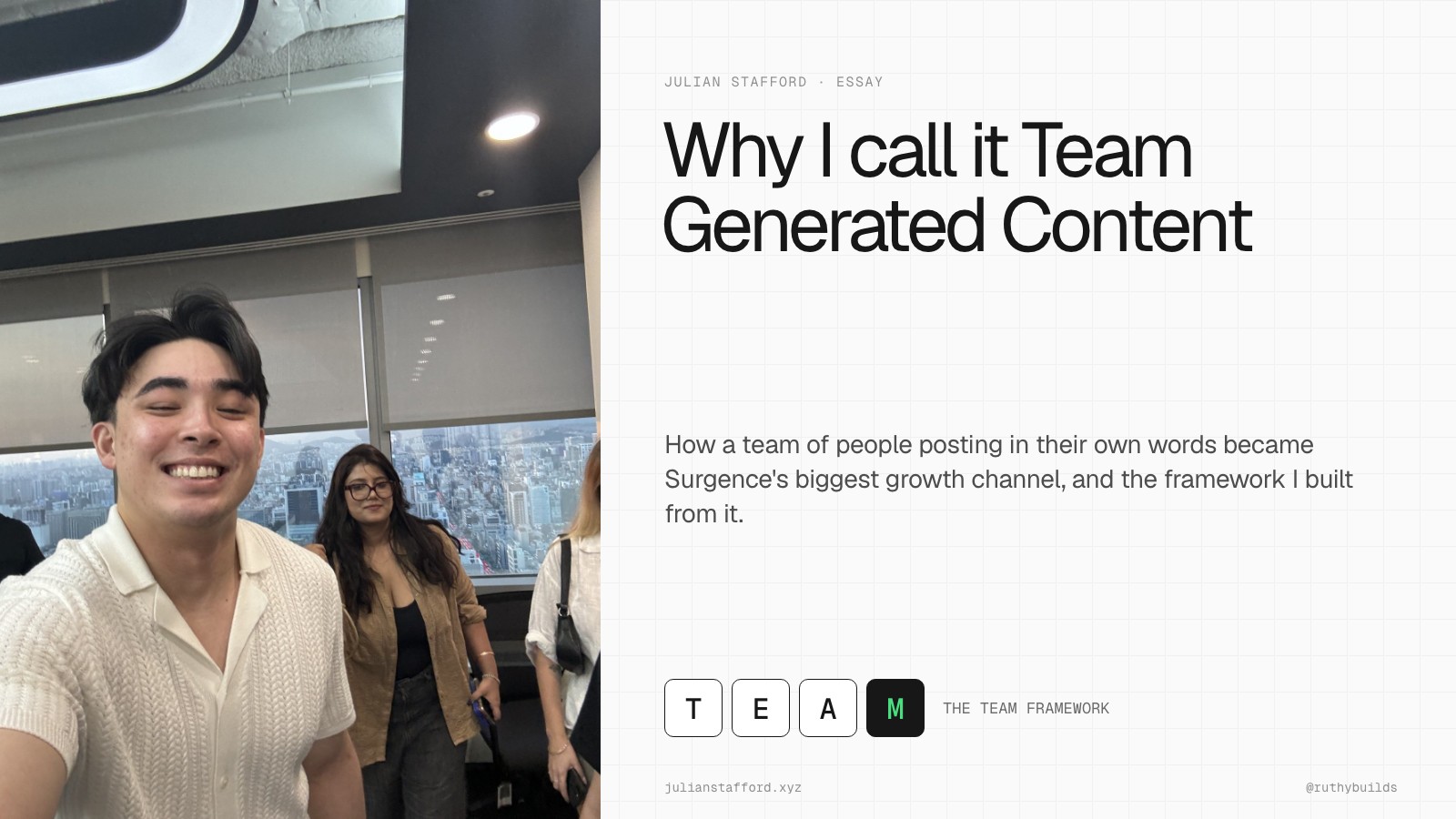
I'm Julian Stafford, co-founder and CEO of Surgence Labs, a go-to-market studio for AI and blockchain teams. Before Surgence I was an early hire at Neara, the AI company now valued at $1B+, where I sold $5M+ of AI software and later led product and GTM for an AI model in the Bay Area. I've spent most of my career on one question: how does a company get in front of the people who will buy from it, without paying for every single view?
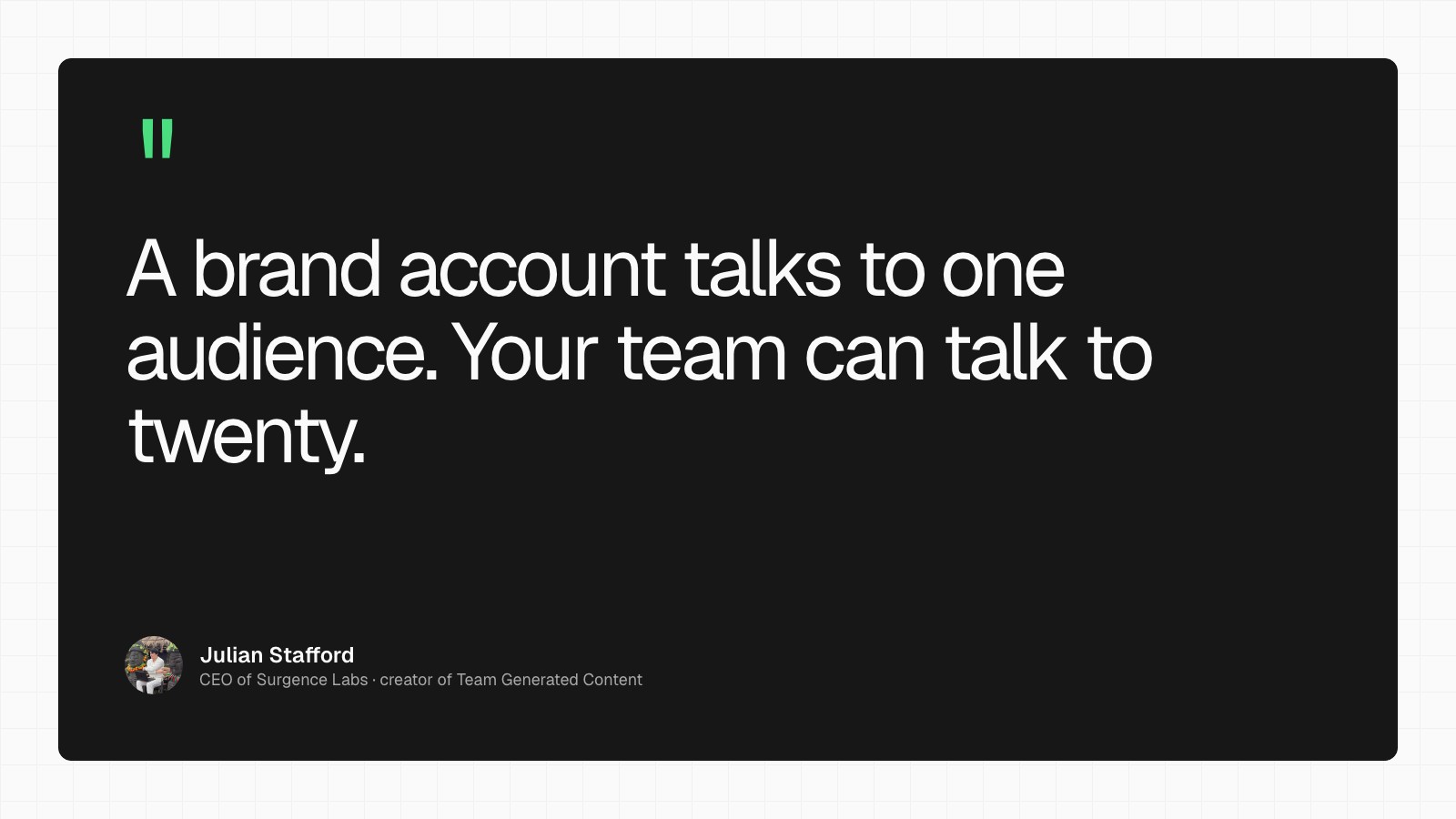
The best answer I've found is a team posting in their own words. Most people call it employee generated content. I call it Team Generated Content, and this is why the name matters.
It started as a joke about "questionable practices"
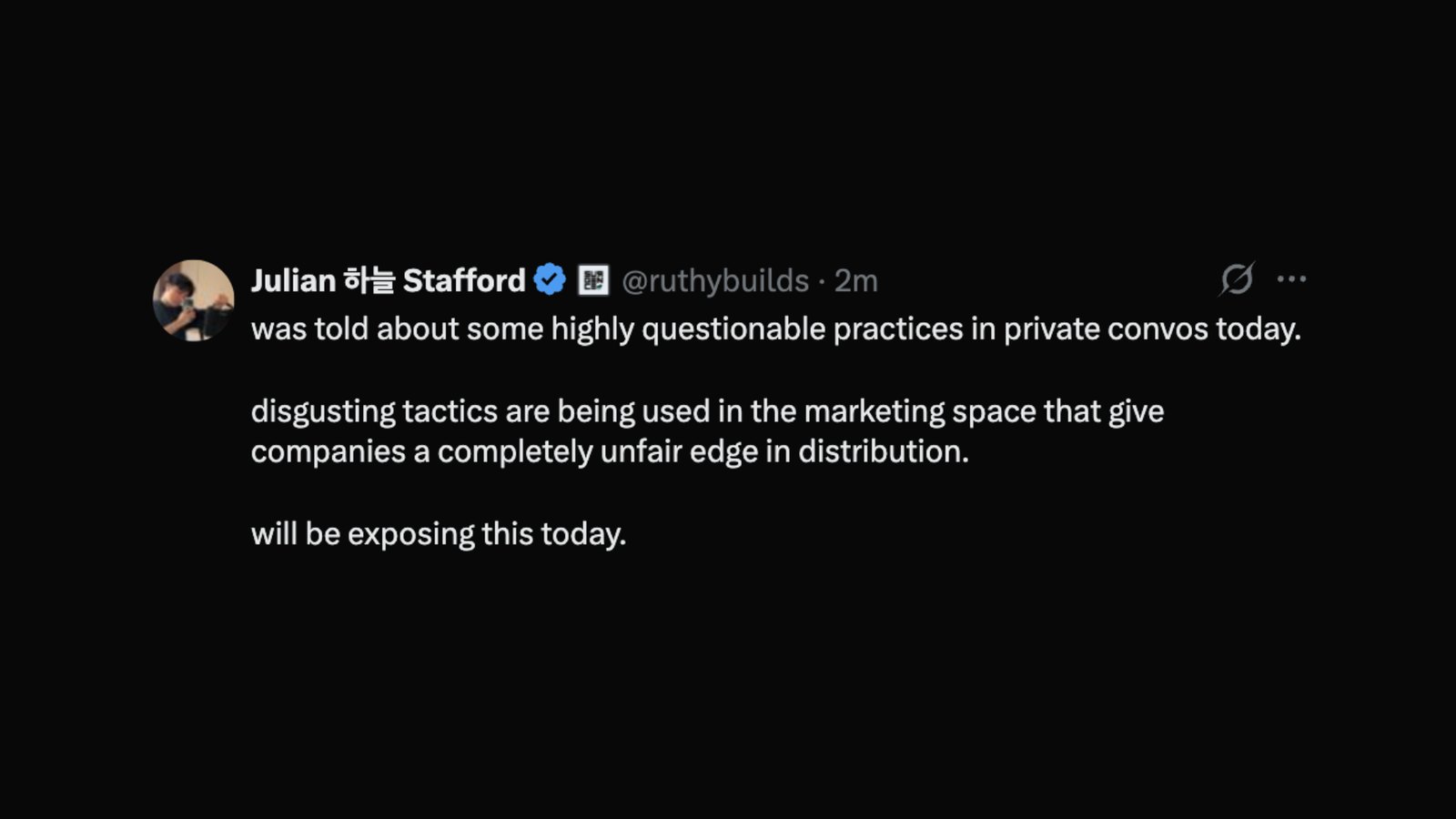
I opened my video on this topic with a post saying I'd been told about some highly questionable practices in private conversations, tactics that give companies a completely unfair edge in distribution. The "questionable practice" was getting the people you already pay to post.
It's a joke, but the edge is real. Shown Media is bootstrapped, and its 22 team accounts pulled 11.8 million views on X in 30 days. Vercel's team averages about 700,000 views per person a month. Shown says its program did 21 million impressions on a $10,000 prize pool, when buying that reach would cost over $100,000.
Why "employee generated content" wasn't the right name
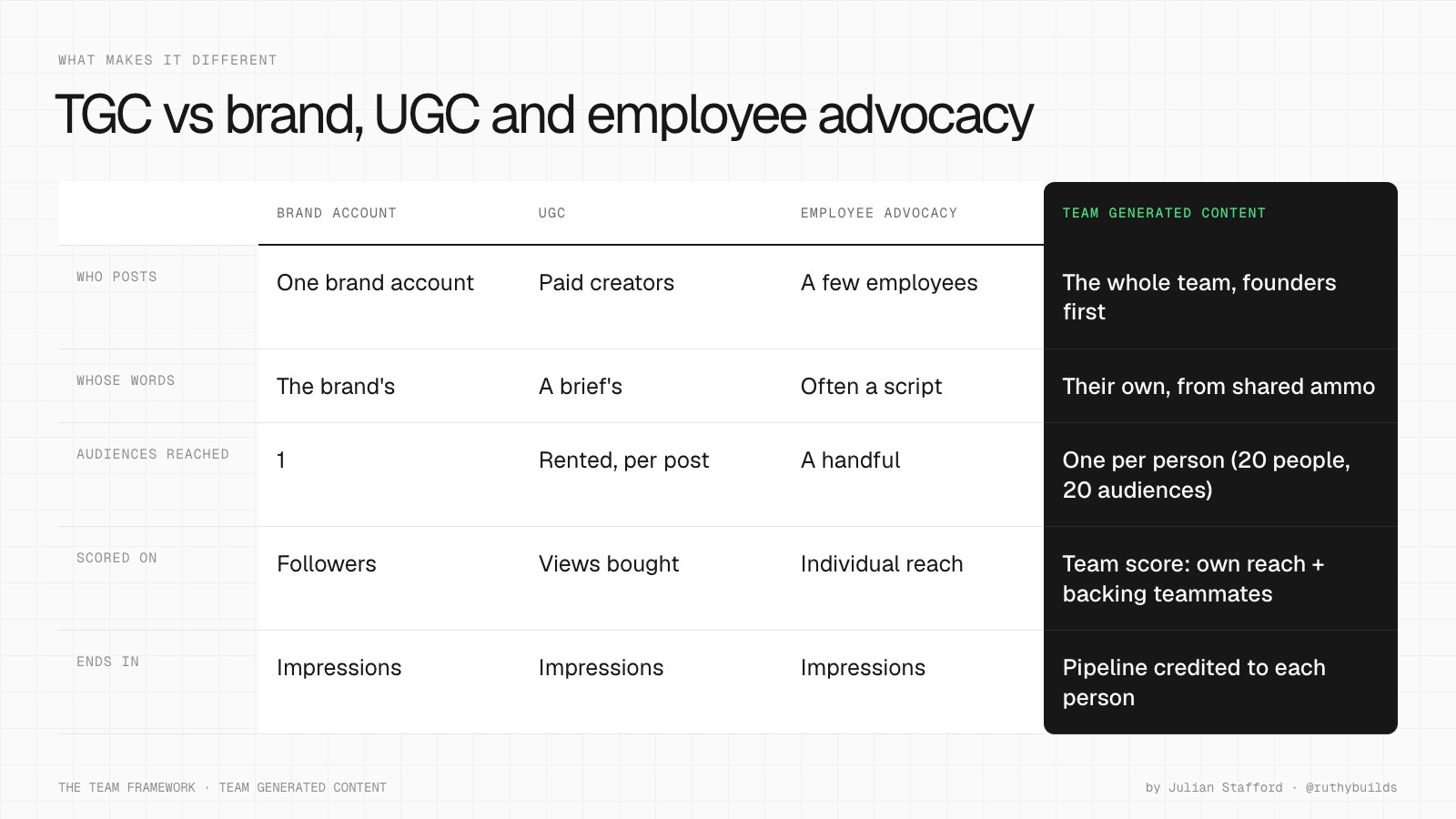
"Employee generated content" describes who is posting. It says nothing about what happens next. Most employee programs I've looked at in tech marketing end at impressions: a few people share company posts, someone counts the views, and the program fades out after a quarter.
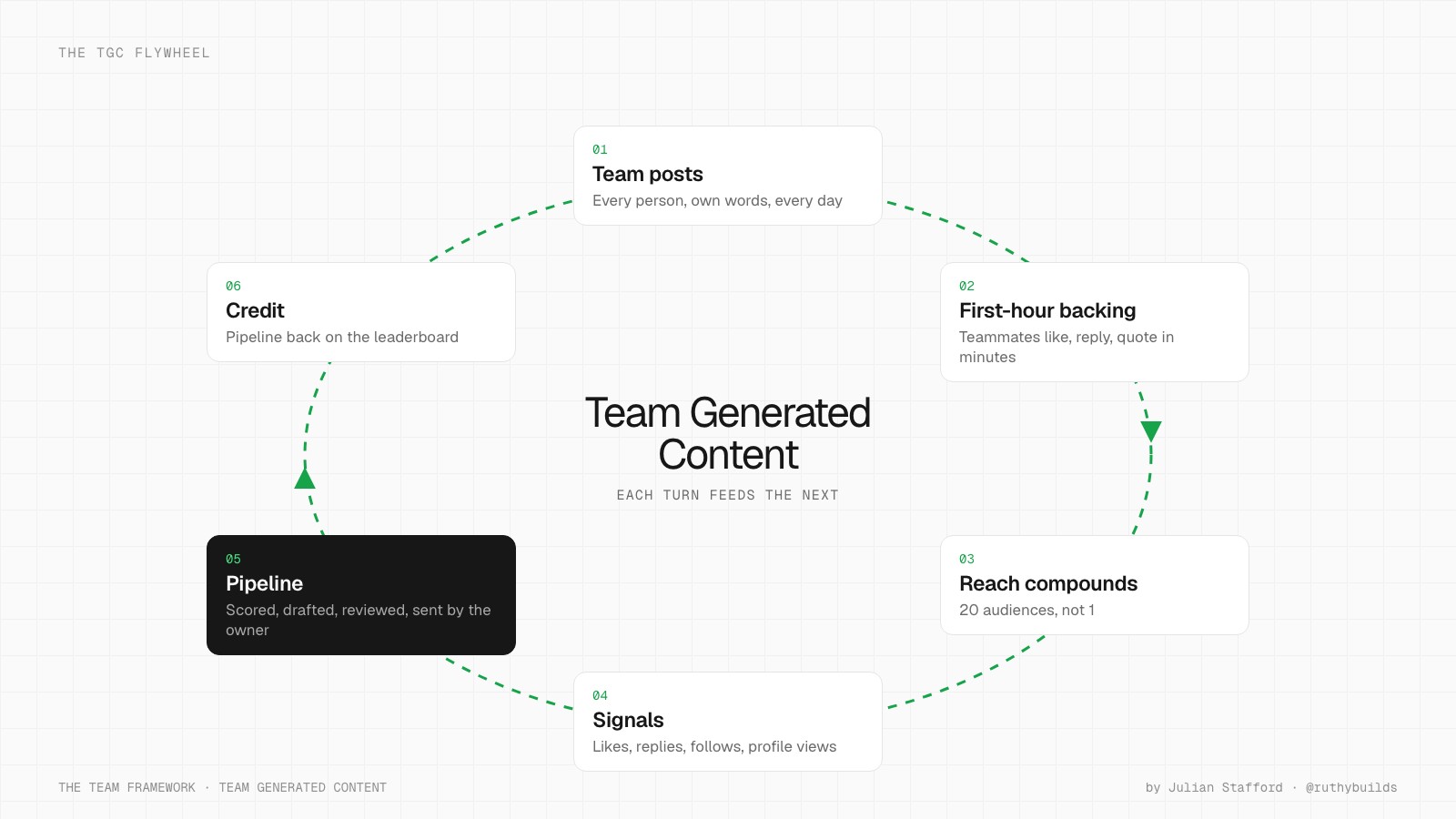
The system I built at Surgence, and now recommend, is different in three ways, and "team" is the word for all of them.
- The team is scored, not just individuals. When you only rank people, three compete and twenty watch. When backing a teammate in the first hour earns points too, the best posters need everyone else.
- The team shares the material. Nobody gets a script. Everyone gets the same library of customer wins, data and stories, and writes about it in their own voice.
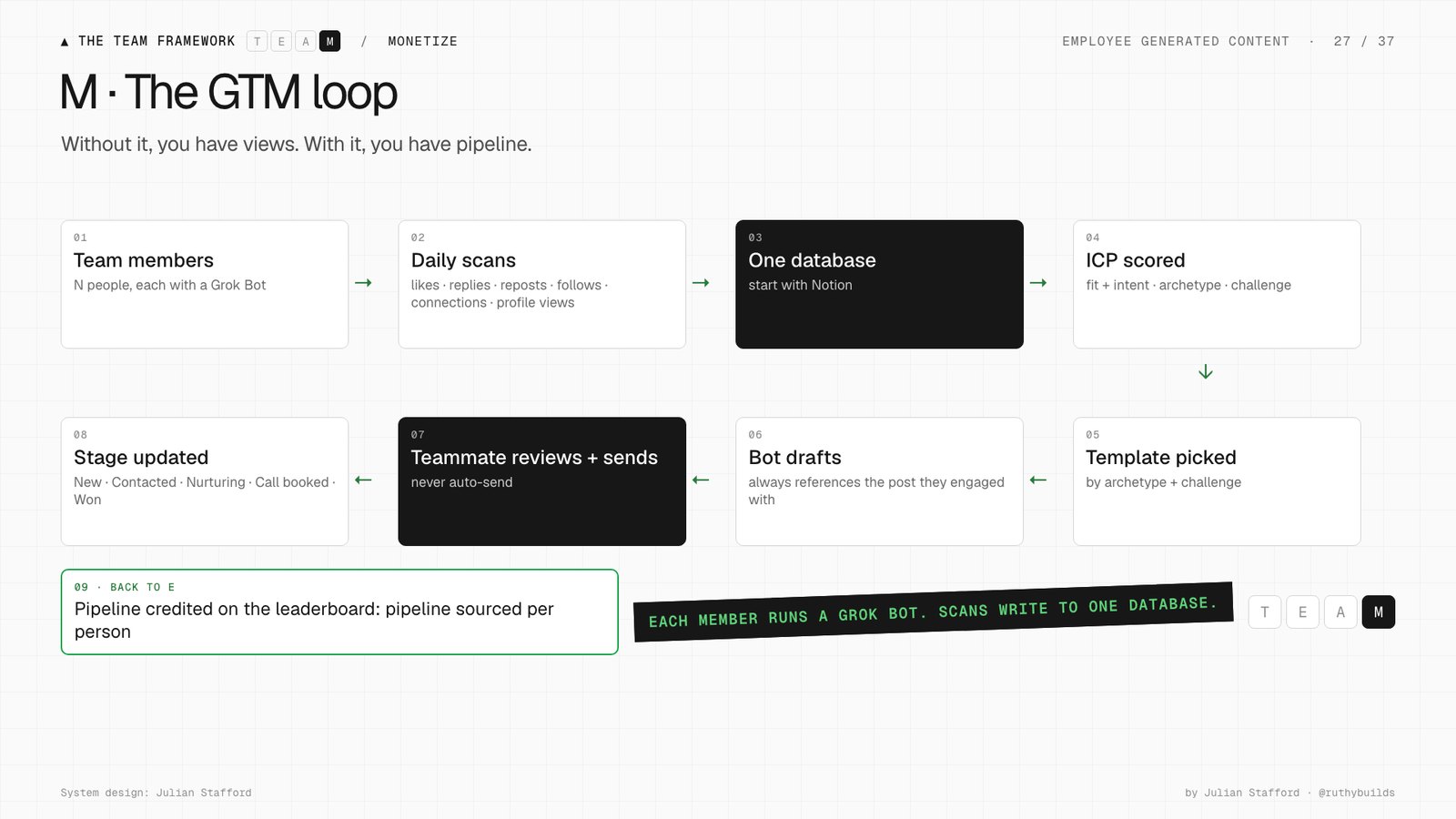
- The team shares the pipeline. Every like, reply and follow on any teammate's account goes into one database, and the pipeline it creates is credited back to the person who earned it.
The TEAM framework
I broke the system into four parts so any company can run it: Talent with reach, an Engine you can measure, Ammo and moments, and Monetize.
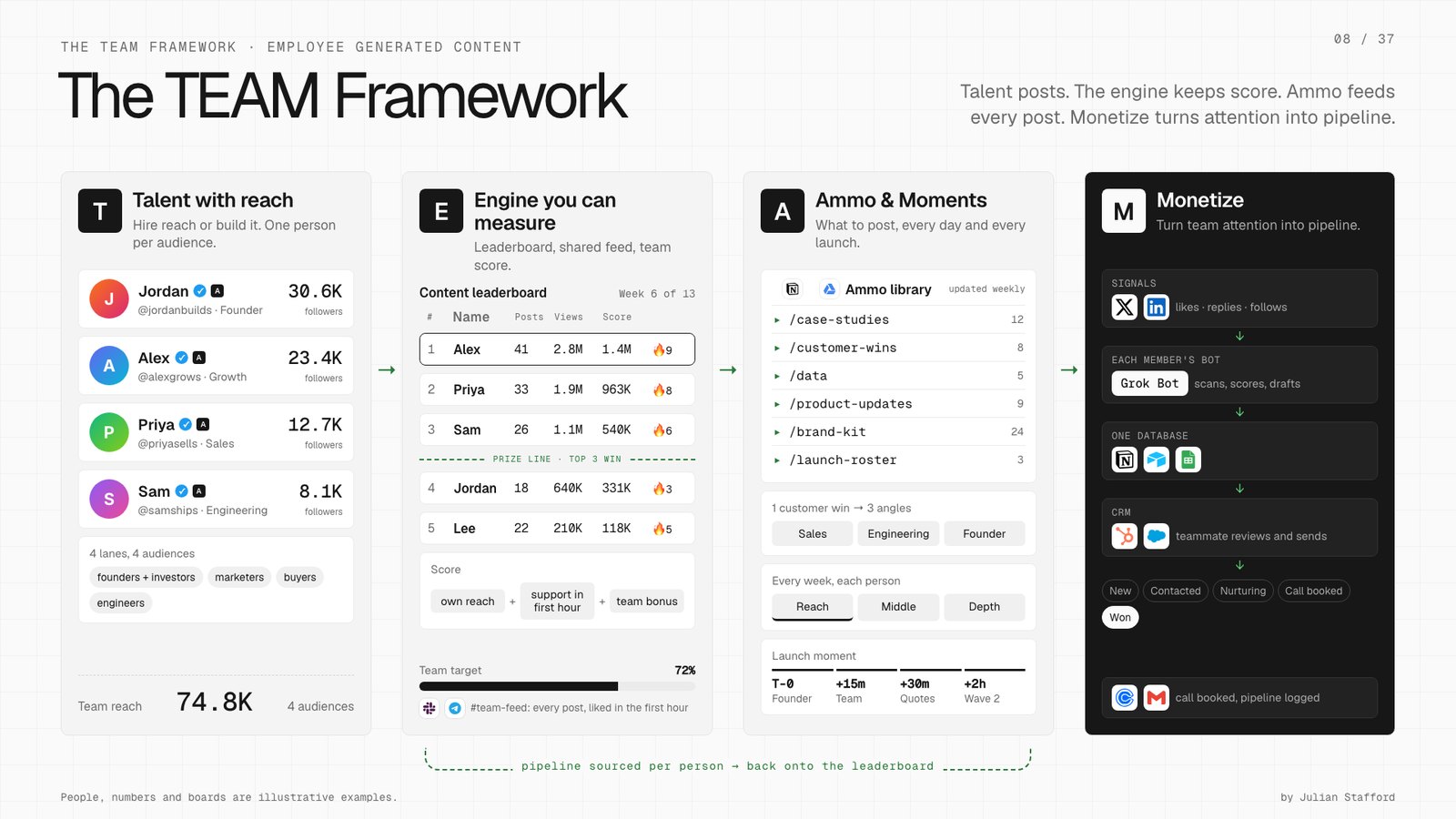
The first three are where most of the public conversation is: hire people with an audience or build one with a daily routine, put a leaderboard in front of everyone, and feed people things to post. The fourth is the one I almost never see anyone build, and it's the one that pays for the rest.
What I learned posting it myself
Here is what posting every day has taught me.
Different posts do different jobs. My Meta ads teardown got about 12,000 views, and almost every one came from the exact people I sell to. It booked sales calls. My Frontier GTM conversation with Faded reached over a million views. My list of the top 10 unicorns from UNSW reached 57,000 people on LinkedIn and made my name known to people who'd never heard it. I judge each one on its own numbers.
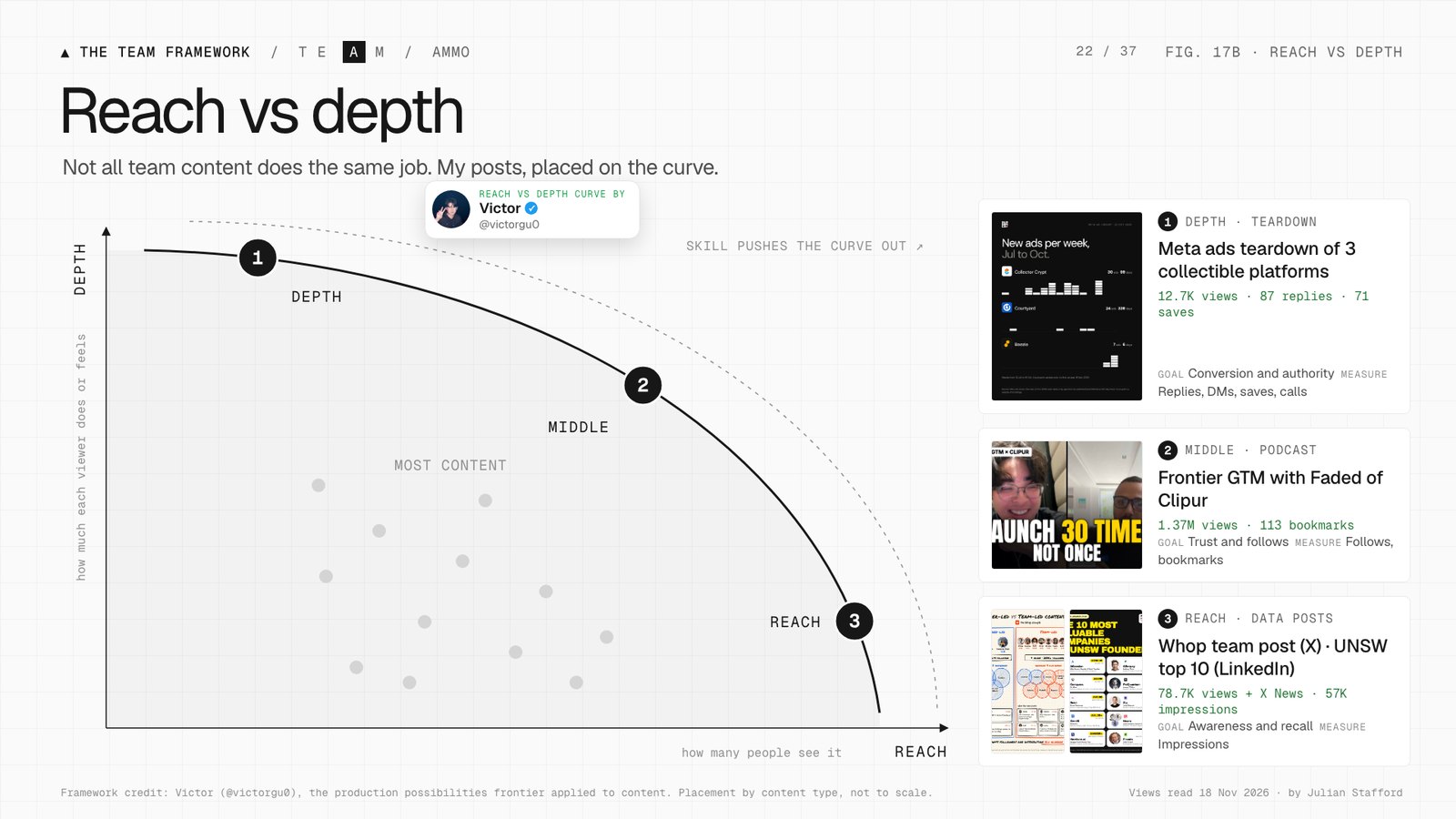
Volume beats polish. Most posts do nothing and a few take off. The number of attempts matters more than any single post.
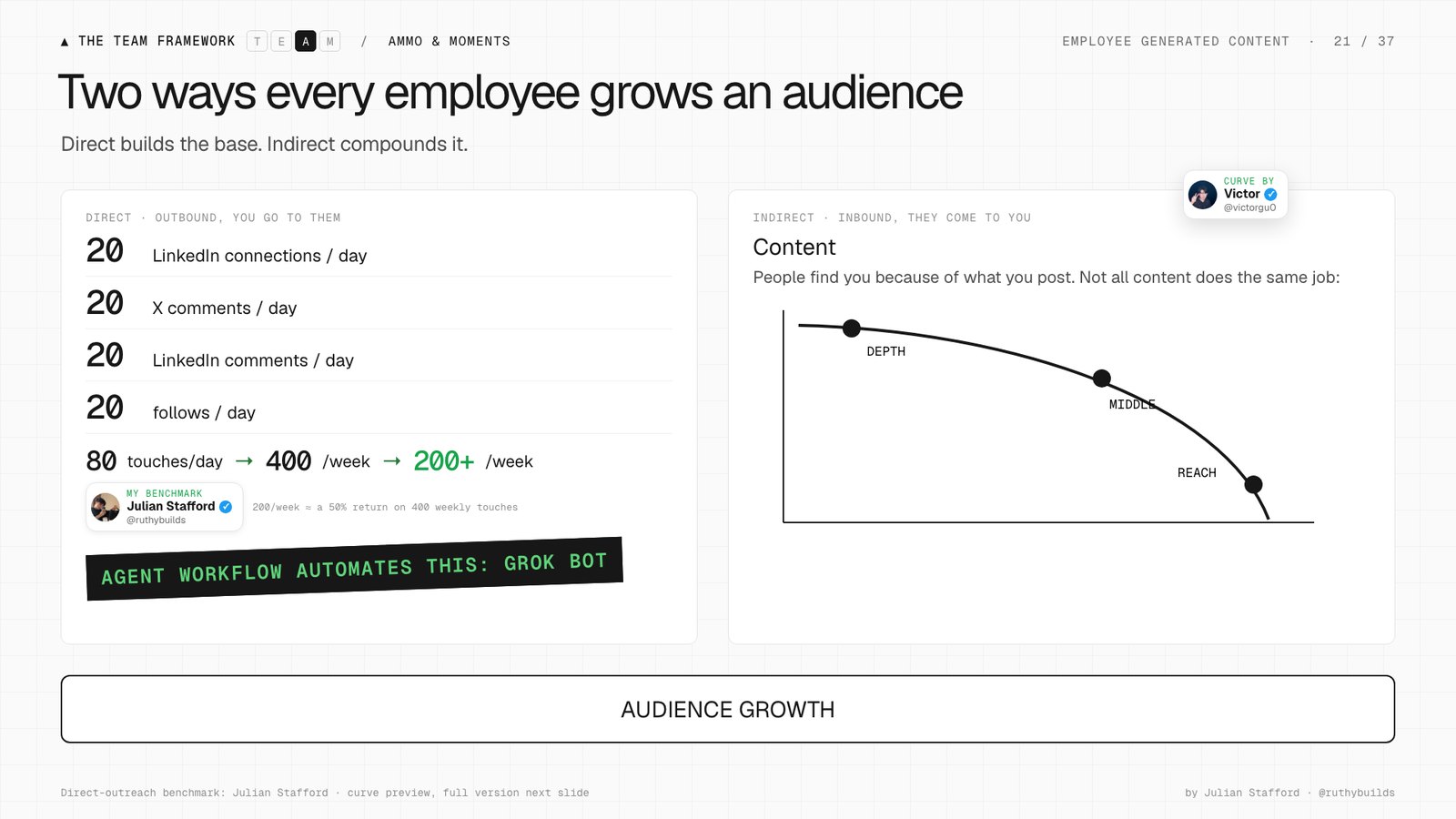
The direct work compounds. Twenty LinkedIn connections, 20 comments on X, 20 on LinkedIn and 20 follows a day is about 400 touches a week, which for me brings around 200 new followers and connections. An AI agent finds my 60 people every morning, so the routine takes minutes.
Where AI marketing fits, and where it doesn't
AI has made brand content cheap and endless, which is exactly why real people posting under their own names stand out. In our system AI does the repetitive work: finding people to engage, scanning every account for signals, scoring leads and drafting first messages. People write every post and send every message. The moment AI writes the posts, you've lost the one thing that makes Team Generated Content work.
If you want to try it
Start with three people for 30 days. One lane each, a post every day, a shared channel for backing each other in the first hour, and one database for every signal. Set a baseline in week one and beat it every week after. Here's the whole thing on one page.
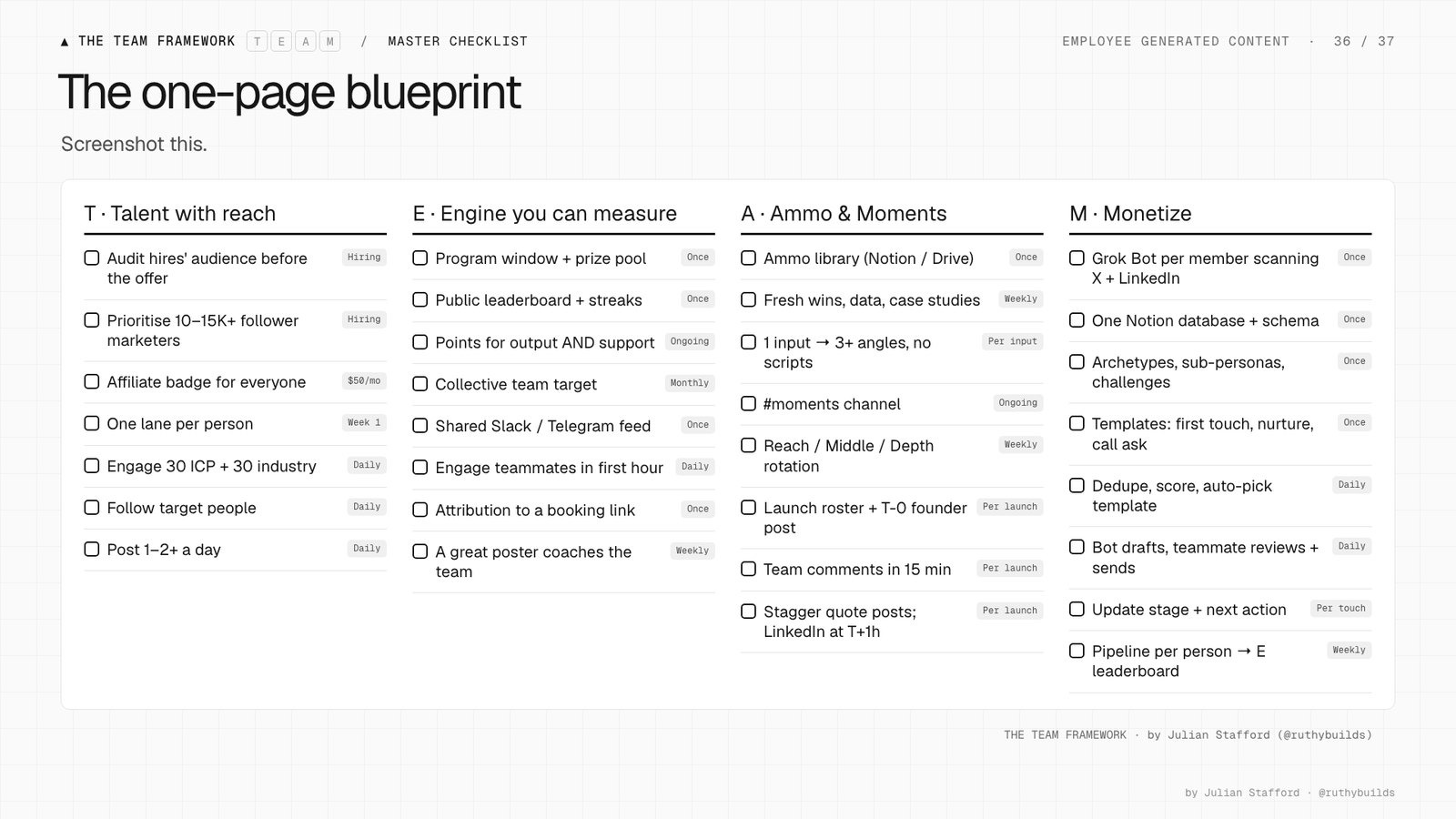
The full TEAM framework guide, with every checklist, the database schema and the launch-day roster, is on the Surgence Labs blog. If you want it running in your company, that's what we do at Surgence Labs.
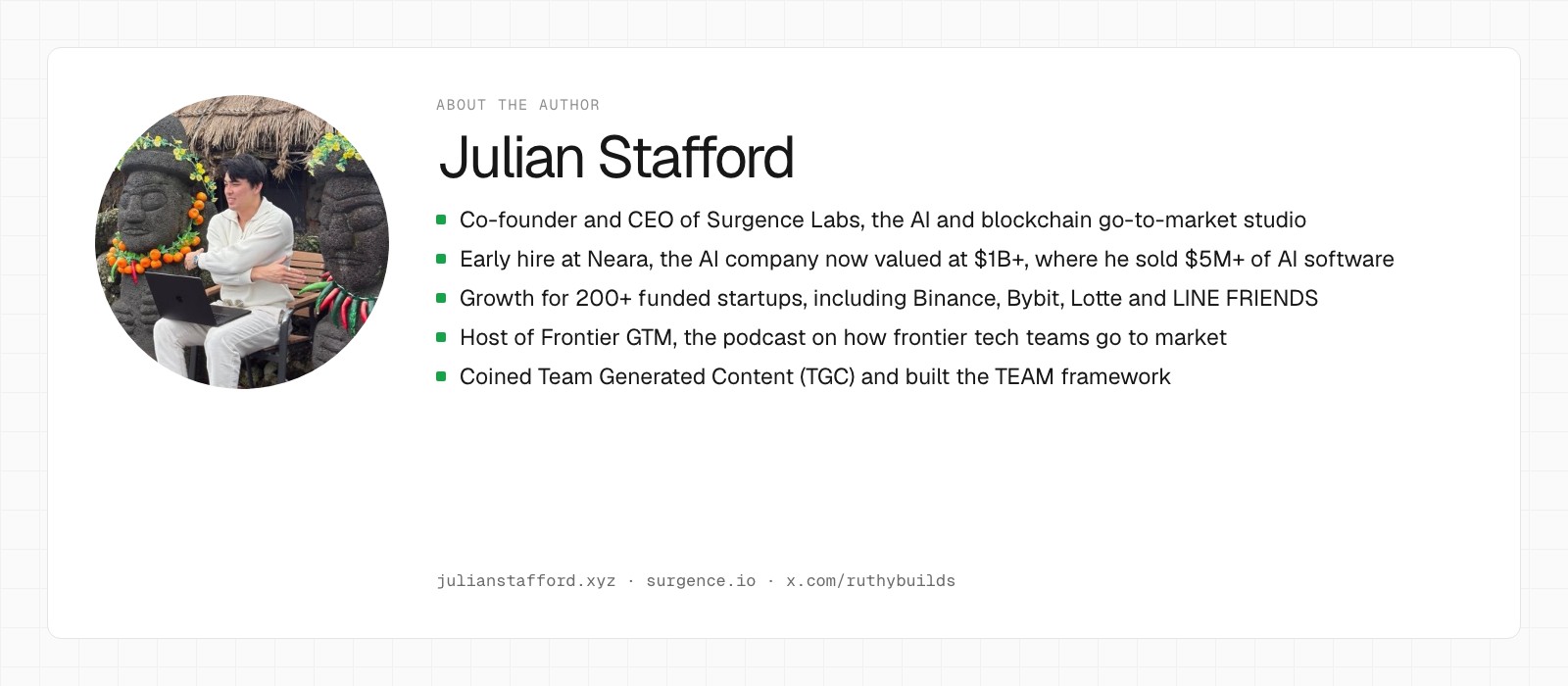
Julian Stafford is the co-founder and CEO of Surgence Labs, the AI and blockchain go-to-market studio, and the host of Frontier GTM. He coined Team Generated Content (TGC) and the TEAM framework. Follow him on X at @ruthybuilds.
Thanks to the people whose work this builds on: Mitchell (@MitcheIl), Matt Epstein (@mattepstein), Hector Serrano (@hectorserrranoo), Steven Schwartz (@cultured), Logan Gott (@LoganTGott), Victor (@victorgu0) and Andrew Shin (@andrewcshin7). Shown's figures are self-reported; X figures were read 15 to 18 November 2026.
Tech Marketing and GTM
My newsletter on tech marketing and go-to-market for AI and blockchain teams. Each new edition reaches you by email and LinkedIn notification.
Subscribe on LinkedIn ↗